Subatomic - COSMOGENESIS THEOREM
The First Motion
\[A+B+C=D \quad (1)\]
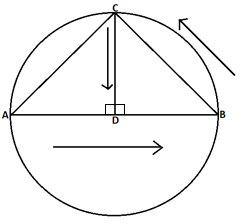
Second Motion
\[A+B=C \quad (2)\]
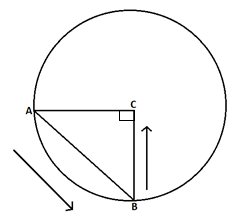
1st Motion Differentiate
\[\frac{A+B+C}{2}=\frac{D}{2}\]
\[(A+B+C)(A+B+C)=D \times D\]
\[A^2+AB+AC+AB+B^2+BC+AC+BC+C^2=D^2\]
\[A^2+2AB+2AC+B^2+2BC+C^2=D^2\]
NB: Now only focus on the central points.
\[A^2+B^2+C^2=D^2 \quad (3)\]
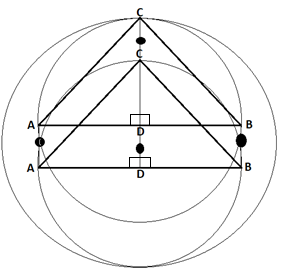
2nd Motion Differentiate
\[\frac{A+B}{2}=\frac{C}{2}\]
\[(A+B)(A+B)=C \times C\]
\[A^2+2AB+B^2=C^2\]
NB: Now only focus on the central points
\[A^2+B^2=C^2 \quad (4)\]
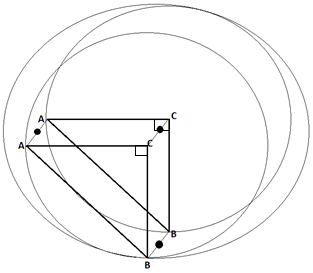
Focus on the Product of the Centres
\[A^2+B^2+C^2=D^2 \text{ is opposite } A^2+B^2=C^2\]
\[+(A^2+B^2+C^2)-(A^2+B^2)=D^2-C^2\]
\[A^2+B^2+C^2-A^2-B^2=D^2-C^2\]
\[C^2=D^2-C^2\]
\[D^2=2C^2 \quad (5)\]
\[C^2=\frac{1}{2}D^2 \quad (6)\]
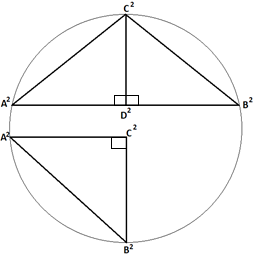
E. Verification of the Differential Process
It is critical to verify that D²=2C² because this is the basic relationship found to exist between the evolving forms of Primordial mass and dark energy in this theory. Let us then follow an algebraic representation of the length of each side found in the cosmogenesis theorem which also follows the Pythagorean fundamental principles pertaining a right angle triangle stating that: The sum of the squares of the lengths of the two shorter sides is half of the square of the length of the hypotenuse).
Let the sides be:
A = x-y
B = x+y
C = z
D = k
\[z^2={(x-y)}^2+{(x+y)}^2\] \[z^2=2x^2+2y^2\] \[\frac{1}{2}z^2=x^2+y^2\] \[k^2={(x-y)}^2+{(x+y)}^2+{(x-y)}^2+{(x+y)}^2\] \[k^2=2x^2+2y^2+2x^2+2y^2\] \[k^2=4x^2+4y^2\] \[k^2=2(2x^2+2y^2)\] \[k^2=2z^2\]
A = x-y
B = x+y
C = z
D = k
\[z^2={(x-y)}^2+{(x+y)}^2\] \[z^2=2x^2+2y^2\] \[\frac{1}{2}z^2=x^2+y^2\] \[k^2={(x-y)}^2+{(x+y)}^2+{(x-y)}^2+{(x+y)}^2\] \[k^2=2x^2+2y^2+2x^2+2y^2\] \[k^2=4x^2+4y^2\] \[k^2=2(2x^2+2y^2)\] \[k^2=2z^2\]
Based on the cosmogenesis theorem, at the subatomic level the force of Dark Energy is twice the force of gravity (FDE = 2FG).